
You get your monthly antique booth statement, and your sales look pretty good. A dresser sold, several smalls found new homes, and you brought in enough to cover rent.
But how much of that money do you actually get to keep?
That’s the question an antique booth profit calculator can help you answer.
After years of selling in antique booths, I know how easy it is to focus on the sales total. Finding treasures, creating displays, and seeing those sold notifications are the fun parts!
But if you want your booth to provide income, you need to know what’s left after your expenses.
Below, I’ll walk you through calculating your monthly profit, share a calculator to make it easier, and offer a few practical ways to improve your earnings.
Why Track Your Antique Booth Profit?
There’s nothing wrong with having a booth because you love vintage shopping and decorating. It can be a wonderful creative outlet and a really fun hobby.
But if you also want to make money, you need to learn how to understand and manage your business numbers.
Your sales total only tells part of the story. You also need to understand your expenses, cost of goods, and the cost of your time.
Tracking your profit helps you figure out:
- Whether your booth income is worth the time you spend
- Which items are worth buying again
- Whether your prices cover your costs
- How much you can afford to reinvest
- Whether expanding your space makes financial sense
It also helps you make decisions based on more than how a particular month felt. A smart business owner make decisions based on numbers, not so much on feelings.
A big furniture sale can feel like a huge success. But if that piece cost a lot to buy and repair, it may have earned less than a shelf of smaller finds.
Knowing your numbers helps you see the difference.
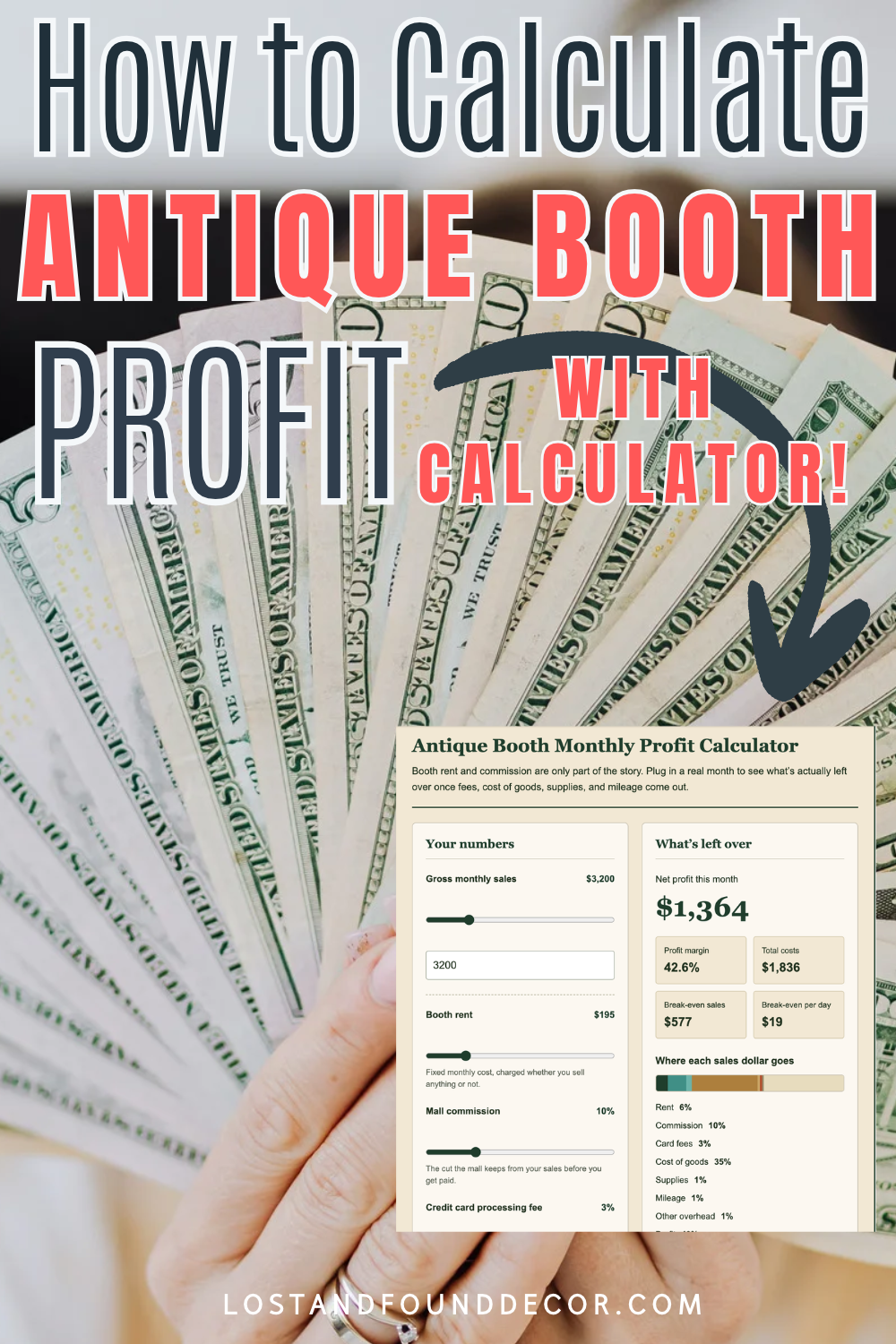
Antique Booth Profit Calculator
Ready to find out what your booth earned this month?
Use the antique booth profit calculator to see your real numbers with expenses and costs figured in.
Before you start, gather:
- Your monthly antique mall sales statement
- Purchase costs for the items that sold
- Booth rent, commission, and other fees
- Any additional booth expenses
Booth rent and commission are only part of the story. Plug in a real month to see what’s actually left over once fees, cost of goods, supplies, and mileage come out.
miles ×
$/mile
hours ×
$/hour
Not sure what to enter? Let’s walk through the numbers.
How to Calculate Antique Booth Profit
The basic formula is:
Monthly sales − cost of items sold − booth expenses = monthly profit
You don’t need a complicated bookkeeping system to start. Even just these most basic numbers can get you a long way.
Start With Your Monthly Merchandise Sales
Find your total merchandise sales after discounts and returns, but before rent, commission, and other mall fees are deducted.
Leave out sales tax collected from customers. That isn’t income your booth earned.
Subtract the Cost of the Items That Sold
Next, add up what you originally paid for the merchandise sold during that month.
Here’s an important distinction: Count what you paid for the items that sold, not everything you bought that month.
Maybe you spent $300 at an estate sale, but those purchases are still in your garage waiting to be cleaned and tagged. They used cash, but they aren’t part of this month’s sold merchandise.
A simple inventory list makes this step much easier. Assign each item a number and record its purchase cost. When it sells, match the number on your sales report to your inventory record.
For a group purchase, divide the total cost among the pieces using a reasonable, consistent method.
If you don’t have an inventory tracking system, I can help! Grab my Inventory Quick Start Guide here.
Subtract Your Booth Expenses
Rent is usually the first expense that comes to mind, but remember the smaller costs, too.
Your booth expenses might include:
- Monthly rent
- Mall commission
- Additional credit card fees (skip if these are not charged by your mall)
- Price tags and packaging
- Cleaning and repair supplies
- Business transportation costs
- Advertising or software
- Paid help
Include only the portion that belongs to your booth business, and count each cost once. For example, if repair materials are already included in an item’s recorded cost, don’t subtract them again as a separate expense.
What About Being Paid for Your Time?
In the antique booth calculator above, you can choose to add a personal “wage” for yourself as you count your profit. Why would you want to do this?
Well, many booth owners consider their time is free. But it most certainly is not!
If you never account for the value of your time, you may never see the full picture of your booth’s financial health.
Also, when you start to account a wage for your time, it helps you be more strategic. Maybe you’re spending 5 hours each Saturday at garage sales looking for inventory, when you could focus on attending one or two good estate sales each month instead.
If you’re just starting out, of course it can be hard to understand the value of your time. And that’s ok to hustle and grind a bit while you build your business.
But eventually, I encourage you to see your time as deserving of a wage and factor that into your profit assessment.
HELPFUL PRODUCT: Business Budget Tracker, Monthly Cash Flow Planner
Why Your Profit May Look Different From Your Bank Balance
Have you ever had a good sales month but wondered where all the money went?
Sometimes the answer is sitting in your garage . . . waiting for a price tag.
Buying more inventory uses cash. But when those items haven’t sold yet, their purchase costs aren’t included in the sold inventory calculation above.
For example, you might earn $550 in monthly profit and then spend $400 on fresh inventory. That shopping trip leaves you with less cash available, even though the month was profitable.
Track both your profit and your new inventory spending so you can see how the two fit together.
How to Improve Your Antique Booth Profit
Once you’ve used the calculator, you can look for specific ways to increase what you keep.
1. Shop With a Selling Price in Mind
Before buying something for your booth, ask yourself, What can I realistically sell this for, and what will be left after my costs?
A low purchase price doesn’t automatically make something good inventory. Repairs, supplies, and mall fees can eat up the difference quickly.
The goal is to buy pieces your customers want at a cost that leaves enough room for profit.
2. Learn Which Items Earn Their Space
Look beyond which pieces bring the highest prices. Instead, consider what each item earned after its costs, how quickly it sold, how much space it occupied, and how much work it required.
A $40 item that sells quickly with very little prep may be a better repeat purchase than a $200 piece that needs hours of work.
Your own sales records can help you spot those patterns.
3. Give Slow Sellers a Plan
Every piece in your booth occupies space you’re paying for.
If something isn’t selling, try moving it, styling it differently, or checking that its price tag is easy to find.
Sometimes a fresh display is all it needs, and a quick restyling of a vignette can get stale items sold.
If it continues to sit, consider a markdown or another selling channel. Clearing a slow piece can free up money and room for inventory with better potential.
4. Make Your Booth Easy to Shop
Can customers move comfortably through your space? Can they reach the merchandise and find the prices?
A beautiful display still needs to function as a place to shop.
Restock regularly, keep tags visible, and give shoppers a clear view of what you’re selling. Share new arrivals on social media with your mall location and booth number so interested buyers know where to find them.
RELATED POST: 7 Antique Booth Mistakes and Why Shoppers Skip Your Booth
5. Keep an Eye on Small Expenses
Extra shopping trips, unused supplies, and uneeded inventory purchases add up.
Combine errands when possible, use what you already have, and set a buying budget before heading out.
You may be able to improve your profit without increasing sales simply by being more intentional about spending. I’m convinced having an inventory budget each month was the main thing that helped my booth business be long-term successful.
Use the Antique Booth Profit Calculator Each Month
Once your monthly statement arrives, set aside a little time to run your numbers.
Keep a record of the result, then compare several months together. Sales can fluctuate, so a pattern will tell you more than one especially good or bad month.
You don’t have to become a numbers person to build a profitable booth. A simple monthly habit can help you shop smarter, price more confidently, and make better decisions about your space.
And when you’re confident with your numbers, then you have even more reason to get out and enjoy the treasure hunting!
Have you calculated your antique booth profit before, or do you usually focus on your sales total? Let me know in the comments!
You may enjoy these related antique booth business posts:
11 Things To Look for Before Signing an Antique Booth Lease
Tips for Sourcing Inventory Online for Your Antique Booth